A discipline he helped found
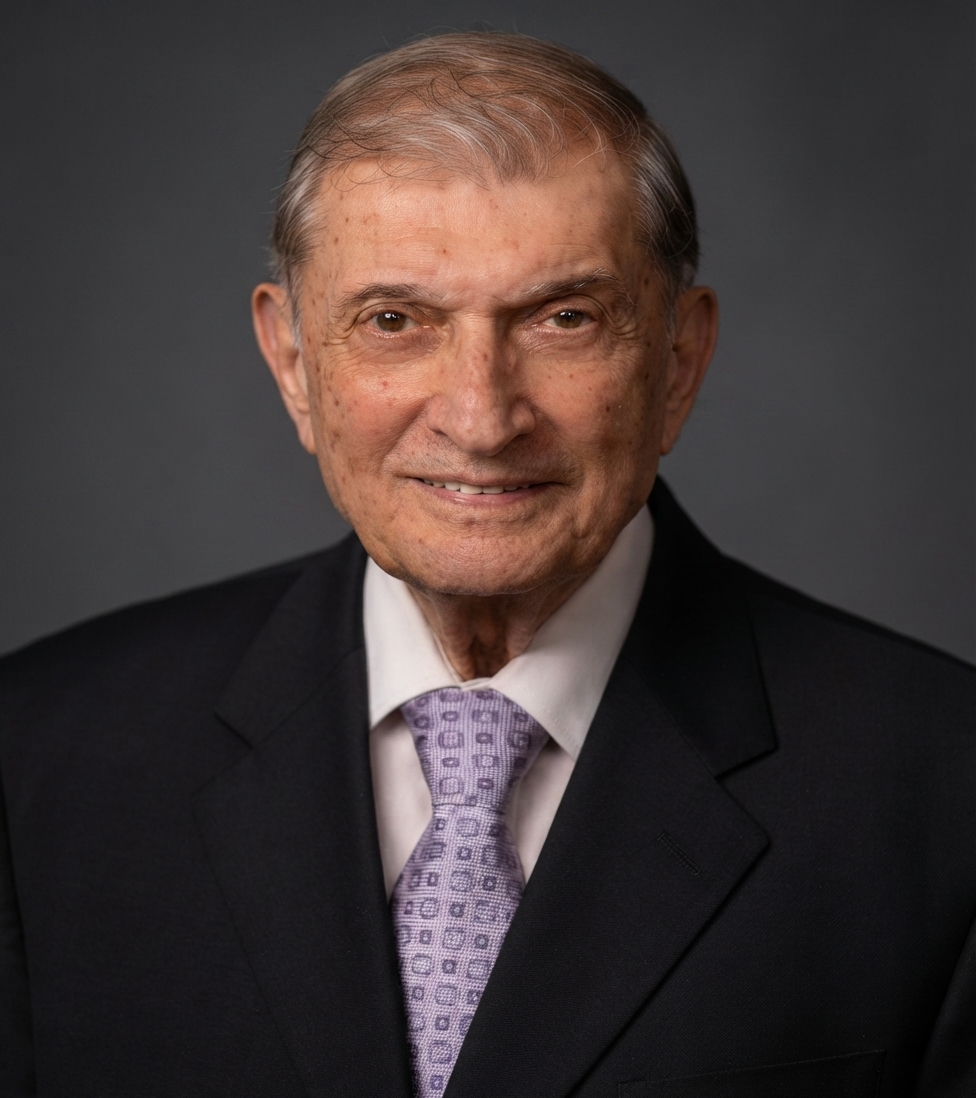
Prof. Ghista's career begins at the moment biomedical engineering barely existed as a named field.
After a PhD from Stanford in 1964, he joined NASA's Ames Research Center, building a biomedical
engineering research program in aerospace medicine and cardiology alongside Stanford Medical School
— work that produced one of the earliest textbooks on cardiac mechanics. At Washington University in
St. Louis from 1969, he taught what were among the first biomedical engineering courses offered
anywhere in the United States, while his valve research with Helmut Reul led to a patented
prosthetic heart valve design (US Patent #94,379) still cited in the surgical literature today.
In 1971, he founded and chaired the Biomedical Engineering Division at the Indian Institute of
Technology, Madras — the first biomedical engineering department in India. It was the first of
several programs he would build from nothing: Chairman of Biomedical Engineering at McMaster
University (1981–87), founding Chair of Biophysics and architect of the College of Medicine at
the United Arab Emirates University (1989–95), and from 2000 to 2006, senior professor at
Nanyang Technological University, Singapore, where he helped plan the university's biomedical
engineering program and served on A*STAR's grants review board.
My connection: I was at NTU Singapore during Prof. Ghista's time there in the
biomedical engineering program (2000–2006).
A shared dream, two different tools
Prof. Ghista and I both ended up chasing the same problem — how a hospital or a health system
should actually be run — but from opposite ends of it. He's a perfectionist and an idealist: he
wants to go high-level, working out how care delivery should be modeled and measured in principle —
papers like "Health-care System Engineering and Administration" (1997) and, later,
"Healthcare Engineering for an Efficient Medical Care System" with P.W. Khong. I'm the one
who prefers the ground — putting the idea into something a nurse or an administrator could actually
open and use today, not a framework to be studied. I don't think either of us would say one matters
more than the other. His high-level thinking is part of why I know what I'm building has to be
measured against something real, not just shipped because it works.
That difference in approach came up directly while I was writing the white paper behind the Nurse
Augmenting System. Prof. Ghista has spent decades on meditation and yoga — not as a side interest,
but as serious, published work of its own, going back to EEG and biofeedback studies of the
meditative state in the 1970s, and more recently a full book on meditation for wellbeing. He felt
strongly that yoga belonged in the NAS framework. I agreed it belonged — I didn't agree it belonged
at the center. NAS-BIO, the clinical readmission-prediction engine, is the operational core of the
system. Yoga sits in the roadmap as NAS-YOG, one of five planned modules alongside nursing support,
traditional Chinese medicine, assistive robotics, and clinical research — a wellness and
rehabilitation layer, not the analytics engine. The same rule applies to traditional Chinese
medicine: support stream, not main stream. Neither is meant to carry diagnostic weight; NAS-BIO
does. That was my way of resolving it: give both a real place, not the headline. Looking back at his
own published work since, I don't think he'd actually disagree with where it landed — even his own
writing on meditation treats the physical health benefits as secondary to the practice's real
purpose, which for him is spiritual, not clinical.
He's 90 now, and still writing. If this page does nothing else, I want it to be an accurate record
of a career most people in this field will never come close to matching — and one small honest note
that even mentors and students don't have to agree on everything to owe each other everything.
Career timeline
| Years | Institution | Role |
|---|
| 1964–69 | NASA Ames Research Center | Research Scientist, Aerospace Medicine & Cardiology |
| 1969–71 | Washington University, St. Louis | Associate Professor, Mechanical Engineering & Surgery |
| 1971–75 | Indian Institute of Technology, Madras | Founding Professor & Head, Biomedical Engineering |
| 1975–78 | NASA / Stanford VA Medical Center | Senior Research Scientist |
| 1978–81 | Michigan Technological University | Professor, Biomechanics & Engineering Mechanics |
| 1981–87 | McMaster University, Canada | Professor & Chairman, Biomedical Engineering |
| 1989–95 | United Arab Emirates University | Founding Professor & Chair, Biophysics |
| 1995–2000 | Osmania University, India | Senior Professor & Head, Biomedical Engineering |
| 2000–06 | Nanyang Technological University, Singapore | Senior Professor, Biomedical Engineering Program |
| 2007 | Parkway College of Health Sciences, Singapore | Founding Provost |
| 2012–present | University 2020 Foundation | President |
Rows in bold mark the four biomedical engineering programs he built from the ground up. Full career detail on his own site (linked below).
A wider vision
What sets Prof. Ghista apart from most engineers of his generation isn't just the range of
institutions — it's the range of subjects he refused to treat as separate. Alongside the
cardiovascular and orthopedic biomechanics work that built his early reputation, his bibliography
spans hospital administration, sports science, cognitive science, sustainable community development,
and a long-running project on socio-economic governance. He has described the university's role as
being "partners in progress" with the community around it — a phrase that could just as easily
describe the standard I've tried to hold the AI systems on this site to: built for the humans who
have to use them, not just for the metrics that describe them.
Socio-Economic Democracy
The "long-running project on socio-economic governance" mentioned above has a name: Socio-Economic
Democracy (SED), and it's the subject of its own book in his bibliography below. In July 2026, Prof.
Ghista sent me his latest article on the subject, "Neo Socio-Economic-Political Restructuring of
Developing and Developed Countries for Promoting Dignified Human Living, Providing the Template for
World Peace," and asked that it be documented here as part of his intellectual legacy — so this
section is his vision, in his words, not mine.
His starting observation: most formerly colonized nations remain underdeveloped no matter which
20th-century path they took — capitalism, which often meant re-inviting foreign multinationals, or
communism, which often meant a regimented, centrally-controlled society. SED proposes a third
structure, built up from seven linked concepts: autonomous, self-reliant local communities; medium
and large corporations organized as worker cooperatives, so people share in the wealth they help
create ("collective capitalism"); a people-centric political system in which professional and civic
associations — teachers, lawyers, doctors — elect their most qualified members to local government,
rather than political parties competing for power; socio-economic democracy itself, meaning shared
wealth creation paired with merit-based governance; broad human rights guarantees, including a right
to employment at a dignified minimum wage; and a nested global structure — local communities grouping
into socio-economic blocs, then zones, then regional federations, ultimately feeding into a global
parliament focused on stability and shared welfare rather than domination by a few powerful nations.
He frames it as a response to what he sees as the root cause of neglect and suffering worldwide:
political systems built around parties and politicians rather than around the people and communities
they're meant to serve. I haven't tried to evaluate the politics of it here — that's not what this
page is for. It's his vision, and it deserves to be recorded as he wrote it.
Read the full article (PDF)
Selected books
- Cardiac Mechanics: Physiological, Clinical, and Mathematical Considerations — I. Mirsky, D.N. Ghista, H. Sandler (Wiley, 1974)
- Applied Biomedical Engineering Mechanics — D.N. Ghista (CRC Press, 2008)
- Cardiac Perfusion and Pumping Engineering — D.N. Ghista, E.Y.K. Ng (World Scientific, 2007)
- Socio-Economic Democracy & World Government — D.N. Ghista (World Scientific, 2004)
- Cardiology Science and Technology — D.N. Ghista (CRC Press, 2016)
- Biomedical Engineering of Pancreatic, Pulmonary, and Renal Systems — D.N. Ghista (Academic Press, 2023)
A selection of roughly 30 authored or edited books. Full bibliography on his own sites, linked below.
Five chapters, one shared byline
That 2023 book above isn't just something I'd recommend — five of its chapters carry my name
alongside his. When Prof. Ghista sent me the list in July 2026, he put it plainly: they "bear
testimony to our unique and visionary collaboration in academic fields." I'll let the chapters speak
for that themselves:
- Chapter 2, Glucose and Insulin Regulatory Kinetics: Detection of subjects who are diabetic
and at risk of being diabetic — Kah Meng Loh, Dhanjoo Ghista, Boyang Su
- Chapter 3, Automated Insulin Infusion Regulation System — Kah Meng Loh, Dhanjoo N.
Ghista, Boyang Su
- Chapter 6, Lung Ventilation Modeling and Medical Assessment — Kah Meng Loh,
Dhanjoo N. Ghista, Boyang Su
- Chapter 8, Lung Alveoli and Pulmonary Capillary Gas Transfer Analysis — Kah Meng
Loh, Dhanjoo Ghista, Foad Kabinejadian
- Chapter 10, Determining Kidney Obstructions by Renogram Data Modeling — Dhanjoo N.
Ghista, Kah Meng Loh, Foad Kabinejadian, Vidya Sudarshan, Yin Kwee Ng, David Chee-Eng Ng
A textbook written in his honour
As part of AEGIS's applied research programme, we produced a full clinical AI textbook built around
Parkinson's disease detection — structured for engineering students and complete with laboratory
exercises, worked examples, and a step-by-step guided project. This is the first textbook AEGIS has
dedicated to a person: Prof. Ghista, whose career in biomedical engineering laid the intellectual
groundwork for exactly this kind of human-centred clinical AI work.
It is freely available here as a tribute. Enter your name and email below — we will send the PDF
link directly to your inbox. If you use it in teaching or research, we only ask that you write
back to us at aegisloh@aegishumanai.com.
✓ Check your inbox
The download link is on its way. If it doesn’t arrive within a few minutes, check your spam folder or write to
aegisloh@aegishumanai.com.
Explore more
This page is a starting point, not a replacement for his own record of his work. For the full
bibliography, career detail, and his current writing:
This page was compiled from Prof. Ghista's own published biography, career pages, and publisher
listings, in July 2026. If you were also a student or colleague of his and want to contribute a
memory or correction, reach out —
aegisloh@aegishumanai.com.